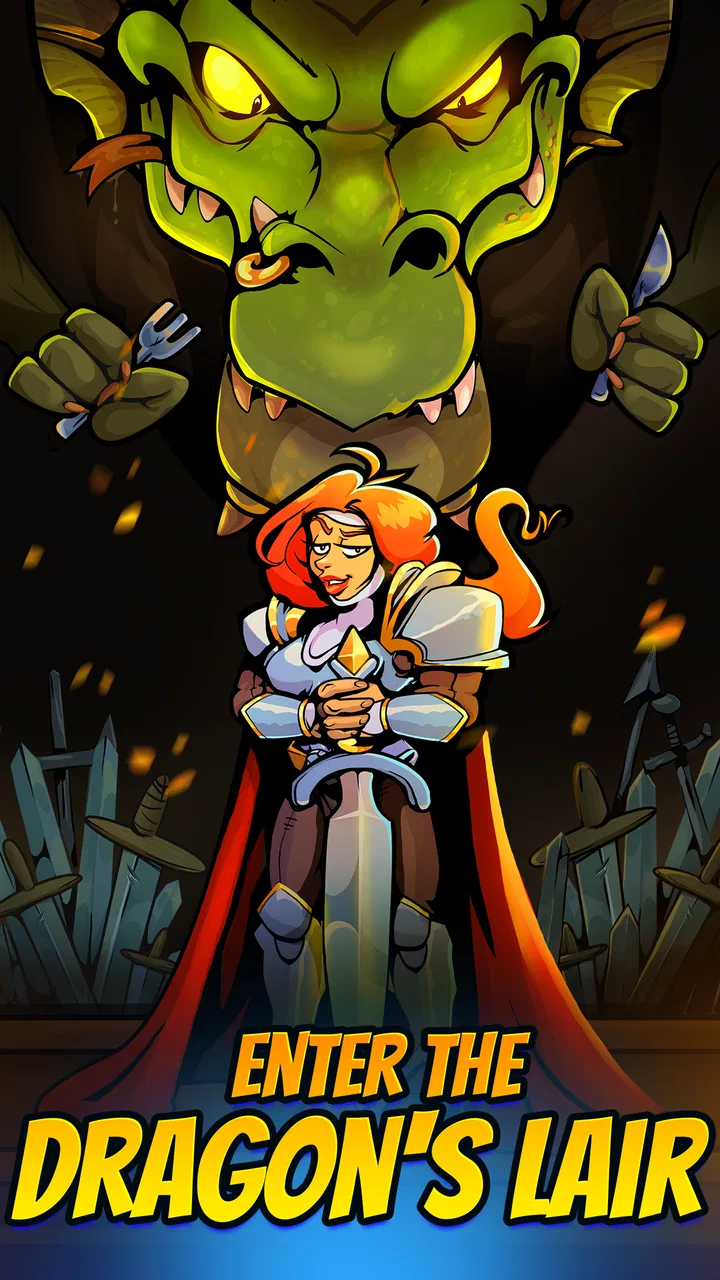
Mobile Dungeon: RPG Crawler
- 4.5
- Rating
- 500.00K
- Installs
- Free
- Price

 Analysis by App-foxy
My first impression of Mobile Dungeon: RPG Crawler was that it understands the appeal of a small, repeatable adventure. This is a free role-playing game from Playa Games built around turn-based battles, idle progression, dungeon exploration, and a roster of champions to collect and summon. I found it easiest to enjoy when I treated it as a game for short sessions rather than a full replacement for a traditional console or PC dungeon crawler.
The basic loop is immediately readable: prepare a group, send it into danger, watch the battle unfold, collect the results, and use those results to make the next attempt stronger. That structure gives the game a comfortable rhythm for checking in during a commute, between errands, or during a short break. It also explains why the game has attracted a 4.5 average from around 26 thousand ratings and more than 500 thousand installs. There is a clear audience for a dungeon game that keeps moving even when I am not giving it constant attention.
That convenience comes with an important condition. This is not a game for someone who wants every fight to depend on rapid manual input or precise movement. Its identity is closer to a management-focused RPG with dungeon-crawler presentation. I make meaningful choices before and between encounters, but the turn-based structure and idle elements do much of the work once a battle begins. If that sounds appealing, the design has a pleasant sense of purpose. If I want direct action, the experience can feel restrained.
You May Also Like

 Blood Strike: 2.5 Anniversary
Blood Strike’s Loadouts Turn Every Drop Into a Tactical Gamble
A close look at Blood Strike’s custom loadouts: how fast access to signature weapons reshapes its battle royale rhythm, rewards preparation, and narrows the gap between fights.

 Pandora - Music & Podcasts
Pandora’s Music Is Easy to Start, but Harder to Recover
Pandora’s strength is its low-effort path from a seed to a station. Its weak spot is how much confidence it asks you to place in connection, setup, and quiet recovery.

 8 Ball Pool
 Is Built on Rivalries, Rematches, and Routine
A close look at the rivalries, rematches, shared routines, and unanswered safety questions that turn a quick pool match into a persistent mobile community.

 Samsung Music
’s Quiet Strength Is Playing What You Already Own
Its reach comes less from spectacle than from dependable access to a personal library. That simplicity is both the app’s strongest retention engine and its ceiling.

 AccuWeather: Weather Radar
AccuWeather Review: A Quick, Clear Forecast for Everyday Decisions
For everyday plans, the best forecast is the one you can understand quickly. AccuWeather makes rain timing, radar, and local conditions easy to act on, with a few trade-offs.

 Hill Climb Racing
Why Hill Climb Racing Still Turns Crashes Into One More Run
A tiny car, a bumpy hill and one more upgrade: Hill Climb Racing keeps resurfacing because its simple chaos makes every near-miss feel personal.
More From Our News Desk
View All News


A dungeon world built through visual cues
The setting works best through its visual language rather than through a large amount of world-building that demands my attention. A mobile dungeon game needs to communicate danger, reward, and progression quickly, and the presentation is strongest when it makes those three ideas easy to read. Champions, enemies, and dungeon spaces need to feel like parts of the same adventure, not disconnected menus leading to unrelated battles.
I also appreciate how the role-playing foundation gives the art direction a practical job. A champion is not merely another icon in a collection; the character needs to suggest a reason to invest in that unit and a role within the group. A dungeon is not just a background; it frames the expectation that each encounter leads to a tougher test or a more useful reward. Even when the underlying systems are numerical, the visual setting helps turn upgrades into a sense of forward movement.
That is where the game’s compact format becomes an advantage. The world does not need to compete with a huge open map or a long cinematic campaign. It can focus on the immediate fantasy of assembling a capable party and sending it deeper into danger. I found that especially suitable for a phone screen, where clear silhouettes and readable battle information matter more than elaborate scenery that disappears behind small interface elements.
There is a trade-off, though. Players who expect a richly authored role-playing story may find the dungeon framework more functional than dramatic. The appeal is in the cycle of collecting, summoning, preparing, and testing champions. I would choose a story-heavy RPG instead if my priority were memorable dialogue, exploration with many side characters, or a world that changes substantially because of my decisions.
Why the visual mood matters to the loop
The art direction supports the game’s most important emotional transition: moving from preparation into risk. Before a fight, I am thinking about the strength and usefulness of my champions. Once the dungeon run starts, the same characters become a team being tested by the environment. That shift makes even an automated or partly idle encounter feel connected to the fantasy of a party adventure.
A useful habit is to pay attention to the difference between a visually attractive champion and a genuinely useful one. Collection games can tempt me to focus on the character I like most, but the better decision is usually to consider how that champion fits the current challenge and the rest of the group. The presentation encourages attachment, while the role-playing mechanics ask for judgment. That tension is healthy when I remember not to spend resources simply because a character looks appealing.
The setting also helps the idle design feel less passive. Instead of thinking of the game as a timer that produces rewards, I can frame the waiting period as a party continuing its expedition. That does not transform idle progression into active play, but it gives the downtime a clearer purpose. For me, this made returning after a few hours feel like checking on an ongoing adventure rather than opening a blank resource screen.
Sound, pacing, and the feeling of a short expedition
Sound is most useful here as a pacing tool. In a turn-based dungeon game, audio can reinforce the difference between preparation, combat, reward collection, and the next decision. Even without treating the game as a cinematic production, those transitions matter because they tell me when I should watch closely and when I can safely let the system run.
The game’s rhythm is naturally divided into small beats. I make a choice, allow the battle to progress, inspect the outcome, and decide whether to continue or improve the team. That pattern suits mobile play much better than a design that expects me to remain focused for a long uninterrupted session. A realistic use case is a lunch break: I can begin a run, check the result when I have a moment, and make a few improvements without needing to reserve an entire evening.
The same pacing can become repetitive if I expect every visit to deliver a new surprise. Idle RPGs depend on repetition, and Mobile Dungeon is honest about that through its structure. The satisfaction comes from seeing a group become more capable and from making better preparation choices, not from manually solving every encounter. I would avoid it if repeated battles without constant input make me feel that I am watching rather than playing.
I found it helpful to separate “progress time” from “decision time.” When the game is resolving a familiar fight, there is little value in staring at the screen. The more interesting moments happen when I decide which champion to develop, whether a run is worth extending, or whether a previous setup has reached its limit. This approach keeps the idle element from feeling like wasted time and makes the active parts of the experience more deliberate.
Another practical point is to avoid treating every reward as an instruction to upgrade immediately. The steady flow of progress can encourage impulsive spending of resources, especially when several champions are available. I get more value by deciding on a small core group first, then investing with a purpose. That reduces the feeling of constantly making tiny upgrades without a clear improvement in battle performance.
Where the pacing works and where it slows down
The pacing is at its best when I want a game that can fit around my day. It is less convincing when I want a strong sense of urgency. Turn-based combat creates room to understand what is happening, while idle systems reduce the need for continuous involvement. Together, those choices make the game approachable, but they also soften the tension that a fully manual dungeon crawler might create.
For a new player, I would suggest resisting the urge to chase every available direction at once. The most useful early question is not “How do I collect everything?” but “Which team can I build consistently?” A stable group makes the progression loop easier to understand and gives later summons or discoveries a meaningful comparison point. This is a more reliable workflow than scattering attention across every new option as soon as it appears.
The free entry point also shapes the rhythm. The game costs nothing to start, but in-app purchases range from $1.99 to $124.99 per item. That wide range is important context for anyone who enjoys collection-driven progression. I can play without paying, but I should approach optional purchases as a convenience or acceleration rather than as a requirement for deciding whether the core loop suits me.
My advice is to establish a personal spending boundary before the collection aspect becomes emotionally persuasive. If I am comfortable with gradual progress, the idle structure has room to work. If I dislike waiting and tend to pay whenever progress slows, this type of game may become frustrating regardless of how attractive the setting is. A traditional premium RPG may be a better fit for someone who prefers one clear purchase and a more predictable progression path.
How the mechanics support the mood
The turn-based format is a good match for the dungeon atmosphere because it makes each encounter feel like a small tactical checkpoint. I have time to read the situation and think about whether my party is prepared, rather than relying on reflexes. The idle layer then keeps the broader expedition moving between those checkpoints. In combination, the systems create a game that feels active in short bursts and relaxed during the gaps.
Champion collection adds a second layer of decision-making. Summoning is exciting because it can change the shape of a party, but it also creates a responsibility: a new character is only valuable if I can use that character intelligently. The strongest approach is to evaluate additions by their practical place in the team, not just by rarity or visual appeal. A champion who completes a dependable setup can be more useful to me than one who simply looks impressive in isolation.
This is one of the game’s less obvious trade-offs. Collection gives the dungeon runs a longer-term purpose, yet it can also pull attention away from learning the existing team. I get the best experience when I treat new summons as tools to test rather than automatic replacements. That mindset keeps experimentation enjoyable and prevents the roster from becoming a crowded list of characters I never properly develop.
The dungeon-crawler structure also makes progression easy to understand. Every improvement has a question attached to it: does this help me survive longer, clear more reliably, or prepare for a harder encounter? When the answer is unclear, I prefer saving resources instead of upgrading by habit. This simple pause is surprisingly valuable in an idle RPG, where frequent rewards can make every button look urgent.
For everyday use, the game works well as a companion to fragmented time. I can check on a run while waiting for an appointment, make a team adjustment before leaving home, or collect progress at the end of the day. It does not ask me to remember a complicated control scheme each time I return. That accessibility is a genuine strength for mobile play, especially for people who want role-playing progression without committing to a long session.
On the other hand, I would not recommend it to someone who wants a highly interactive battle system. The game’s satisfaction depends on preparation and accumulation, not on controlling every action in real time. Players who prefer action RPGs, deep manual tactics, or large exploration spaces will probably find more excitement in another category. Here, the pleasure is quieter: building a team, noticing a weakness, changing the setup, and watching the next attempt improve.
Who should install it
I think Mobile Dungeon is a strong candidate for players who like collectible champions, turn-based encounters, and progression that continues between visits. It is particularly suitable if I want a dungeon theme without the pressure of constant manual control. The Teen content rating also gives a general indication of its intended audience, though the collection and purchase systems still make it worth discussing spending habits with younger players.
The game is less suitable for someone who wants a complete offline-style adventure, a tightly authored campaign, or a one-time purchase with no incentive to accelerate progress. It is also not my first choice for a player who becomes bored by repeating battles. The design asks me to find satisfaction in gradual improvement, and that is a personal preference rather than a universal strength.
Compared with a conventional turn-based RPG, this game puts more emphasis on return visits and roster development than on moving through a long story. Compared with a fully idle game, it gives the dungeon setting and champion decisions more personality and context. Compared with an action dungeon crawler, it sacrifices direct control for convenience. That middle position is its clearest identity, and it is also the best way to decide whether it belongs on a phone.
Practical expectations before starting
The game was released on March 27, 2025, and its current version is 2.001.260305.4. It supports devices running Android 7.1 or later. Those details make it accessible to a broad range of Android users, although the actual comfort of play will still depend on the phone’s screen size and performance. I would give the interface a little time at the beginning rather than rushing through every prompt, because understanding the relationship between champions, rewards, and dungeon attempts pays off later.
It is also worth deciding what kind of player I am before investing heavily in the roster. If I enjoy gradual collection, I can let the game’s pacing work in my favor. If I need immediate variety, I should judge the experience after several short sessions rather than after one quick launch. The first impression is simple, but the real test is whether the repeating loop remains satisfying once the novelty of summoning and early progress settles.
My preferred routine would be to check progress at natural breaks, review the party with a specific goal, and begin the next dungeon attempt only when I know what I am testing. That makes the game feel more strategic and less like a sequence of reward claims. It also helps me notice whether a new champion truly changes my options or merely adds another collection entry.
My atmosphere verdict
Mobile Dungeon succeeds when its art direction, dungeon framing, turn-based combat, and idle pacing all point toward the same promise: a party adventure that can continue in small pieces. I like that I can engage deeply with team decisions for a few minutes and then step away without losing the sense of an ongoing expedition. The mood is compact rather than grand, but it is coherent.
Its limitations are equally clear. The game cannot offer the same immediacy as a manual action crawler or the same narrative weight as a story-led role-playing game. Repetition is part of the design, and the in-app purchase range means players who are sensitive to accelerated progression should set expectations early. Those are not minor details; they determine whether the relaxed dungeon rhythm feels convenient or passive.
For me, the best reason to try it is the balance between collection and low-pressure play. I can build a group, test it against dungeon challenges, and return when I have time rather than when the game demands a long uninterrupted session. The fact that it is free makes that trial easy, provided I remember that optional purchases can become substantial and that patience is part of the intended experience.
I would recommend it to a friend who enjoys watching a roster take shape and making thoughtful improvements between short battles. I would steer a friend toward a different RPG if they wanted constant control, dramatic storytelling, or a fixed-price adventure. As a mobile role-playing game, Mobile Dungeon has a clear personality: it turns dungeon crawling into a steady habit of preparation, progress, and return visits. That atmosphere is not for everyone, but when it matches the way I want to play, it makes the game easy to keep coming back to.
FAQs for Mobile Dungeon: RPG Crawler
01What is Mobile Dungeon: RPG Crawler?
Mobile Dungeon: RPG Crawler is a mobile game that combines classic RPG elements with dungeon crawling mechanics. Players explore procedurally generated dungeons, battle various monsters, and collect loot to enhance their character’s abilities. The game offers a rich storyline and engaging quests, making it a popular choice for RPG enthusiasts.
02Is Mobile Dungeon: RPG Crawler free to play?
Yes, Mobile Dungeon: RPG Crawler is free to download and play. However, it includes optional in-app purchases that allow players to buy items, upgrades, and currency. These purchases are not necessary to enjoy the game, but they can enhance the gaming experience by speeding up progression and unlocking exclusive content.
03What platforms is Mobile Dungeon: RPG Crawler available on?
Mobile Dungeon: RPG Crawler is available on both Android and iOS platforms. Players can download the game from the Google Play Store or the Apple App Store. It is designed to run smoothly on most modern smartphones and tablets, providing a seamless gaming experience across devices.
04Does Mobile Dungeon: RPG Crawler require an internet connection?
Mobile Dungeon: RPG Crawler can be played offline, making it perfect for gaming on the go. However, some features, like updates, leaderboards, and certain multiplayer elements, require an internet connection. Players can enjoy the core gameplay without being connected, ensuring accessibility wherever they are.
05What age group is Mobile Dungeon: RPG Crawler suitable for?
Mobile Dungeon: RPG Crawler is suitable for players aged 12 and above due to its fantasy violence and thematic elements. The game encourages strategic thinking and problem-solving, making it appealing to teenagers and adults. Parents may want to review the content and in-app purchase options before allowing younger players to engage with the game.
Pros
- Immersive and detailed dungeon environments.
- Wide variety of character classes to choose from.
- Engaging storyline with unexpected twists.
- Smooth and intuitive user interface.
- Offers offline play for on-the-go gaming.
Cons
- In-app purchases can be quite expensive.
- Occasional lag during high-action scenes.
- Limited character customization options.
- Energy system restricts extended play.
- Requires frequent updates for bug fixes.

Mobile Dungeon: RPG Crawler
Gallery